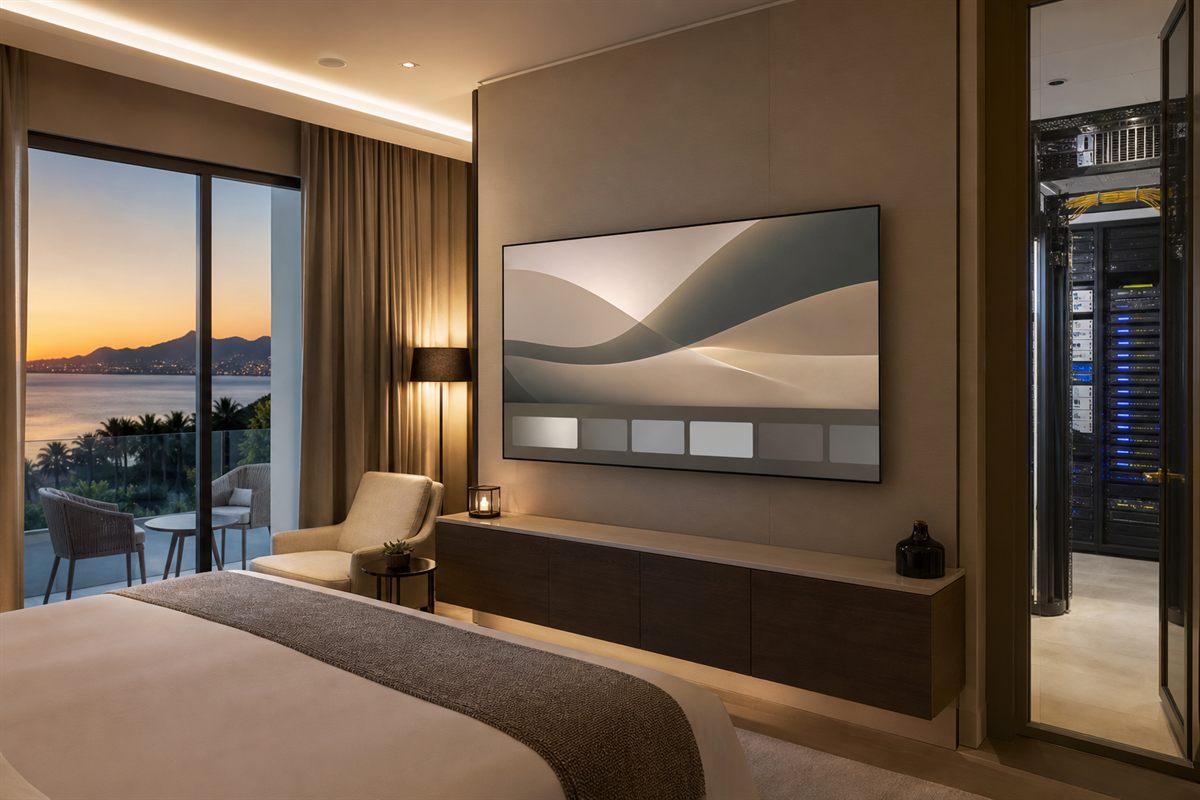
IPTV (Internet Protocol Television) distributes the television signal through the hotel IP network, instead of by independent coaxial cable or satellite. This allows total flexibility: add channels, change welcome screen content, integrate TV with the hotel management system (PMS) and offer on-demand content.
Hotel IPTV headend: the equipment list
A hotel IPTV headend combines the digital headend, each encoder, middleware, the content server, hospitality TVs and PMS integration. It must also match the hotel's GPON or Ethernet network, multicast design, VLANs and support model so channels reach every room reliably before any equipment purchase is approved.
📡Encoder and digital headend
Receives satellite or terrestrial signals, encodes channels and converts them into controlled IP streams for the hotel network.
⚙Middleware
Controls the programme guide, welcome screen, guest services, room messaging and the workflows connected to the PMS.
▣Content server
Stores and distributes hotel information, on-demand media and approved promotional content with centralised management.
📺Hospitality TVs
Managed hotel displays compatible with provisioning, remote configuration, casting policies and the chosen middleware.
PMSPMS integration
Connects guest identity, room status, welcome flows and hotel services without exposing operational data or creating fragile manual processes.
↔Switching and GPON or Ethernet
Carries multicast video through engineered VLANs, QoS, switching and backbone capacity without degrading WiFi or hotel operations.
How the complete hotel IPTV system fits together
A hotel IPTV system should not be bought as a simple television box. It is a full hospitality platform where headend equipment, middleware, PMS integration, guest TV screens, VLAN design, multicast, GPON or Ethernet backbone and maintenance procedures must work as one system.
The right solution matches the building, number of rooms, expected guest experience, existing network and operational capacity of the hotel team. If the property already receives complaints about streaming, casting or coverage, review how to improve hotel WiFi before treating IPTV as an isolated project.
Advantages over analogue or coaxial TV
For the guest
- Personalised welcome screen with guest name
- Access to Netflix, YouTube, Prime Video
- Interactive channel guide (EPG)
- Hotel content: menus, services, maps
For the hotel
- Remote update of content and channels
- Room-specific or general information messages
- Automated upselling of services (spa, restaurant)
- PMS integration: check-out from TV
For maintenance
- Remote diagnostics of each TV
- Centralised firmware updates
- No coaxial cables per room
- Uses existing IP network (GPON or Ethernet)
Hotel IPTV system vs legacy television infrastructure
| Layer |
Hotel IPTV system |
Legacy coaxial TV |
| Content management |
Centralised control, guest messaging and channel changes from one platform. |
Manual changes, limited personalisation and fragmented updates. |
| Scalability |
Easier to grow across wings, rooms and services if the network is ready. |
Expansion often requires more dedicated distribution hardware and rewiring. |
| Guest experience |
Hospitality UI, PMS integration, streaming-ready environment and interactive services. |
Channel access with limited control and fewer upsell or information features. |
| Operations |
Remote diagnostics, documentation and coordinated support with the hotel network. |
More isolated troubleshooting and lower visibility of room-level behaviour. |
Hotel IPTV headend: what should be defined before buying equipment
A hotel IPTV headend should not be treated as a standalone box. It has to be defined together with signal intake, channel plan, compression strategy, output protocols, switching capacity, multicast handling, redundancy expectations and support workflows. The wrong headend choice can create bottlenecks for the whole guest TV experience even when the screens themselves are new.
Before modernising a property, it is sensible to review the existing backbone, room televisions, PMS integration scope, language requirements, content strategy and future maintenance model. That is what turns an IPTV quote into a workable hotel television system rather than another isolated procurement decision.
Related hotel IPTV decisions: system vs equipment
If you are comparing a complete hotel IPTV system, focus on guest experience, PMS workflows, middleware, hospitality TV compatibility and support. If your search is specifically about IPTV headend equipment for hotels, separate hardware selection from the wider network audit so the equipment matches the building, not only the brochure.
Frequently asked questions about hotel IPTV systems
What does a hotel IPTV headend include?
A hotel IPTV headend normally includes signal reception, encoders, channel processing, IP output, middleware or management software, content services, monitoring and the network layer needed to deliver television to rooms and common areas.
What is the best IPTV system for hotels?
The best IPTV system for hotels is the one designed around the property's network, headend, PMS, guest TV requirements and support model. Before choosing a brand or box, review the backbone, multicast capacity, room devices and content workflows.
How much does a hotel IPTV system cost?
The cost depends on rooms, channel plan, PMS integration, middleware, hospitality TVs and the state of the network. A technical audit avoids paying for unnecessary equipment or discovering later that the backbone cannot support the platform.
Can IPTV run over GPON or Ethernet in hotels?
Yes. IPTV can run over GPON or Ethernet if switching, VLANs, multicast, QoS and room connectivity are engineered correctly. The important point is not the transport label, but whether the network can carry video reliably at hotel scale.
How long does a hotel IPTV audit take?
A first audit can usually be scoped in 24 to 48 hours with plans, current equipment data and a technical call. Larger hotels and resorts should validate rooms, headend, racks and support procedures on site.
WANT TO MODERNISE YOUR HOTEL TV SYSTEM?
Request a 24–48h IPTV headend audit
We assess your current network, headend, PMS scope and existing TVs before you commit to equipment.
Request a 24–48h IPTV headend auditIPTV services in Marbella